 Cetus
Cetus combines swap aggregation with liquidity pools
Last updated -
Cetus is a decentralized exchange that connects token swaps on Sui with assets held in liquidity pools. The aggregator finds trading routes across supported Sui liquidity sources, while providers supply assets through range-based or bin-based pools. Vaults automate parts of position management, and intent trading adds scheduled purchases and limit orders. These functions serve different tasks: exchanging an asset, supplying tradable reserves, or arranging when a trade can happen.
Swap aggregation connects a trade to available liquidity
In aggregator mode, a token swap uses the Super Aggregator to compare routes through supported liquidity sources on Sui. Routing can split a trade across paths, so execution needn’t draw all its liquidity from a single pool. Available reserves and trade size influence the quote. A direct pool interaction uses that pool’s liquidity; aggregation searches across its configured sources. The output estimate applies to the selected route and the liquidity available when the quote is calculated. An integrating application can also configure an overlay fee, which adds a cost to that application’s swaps.
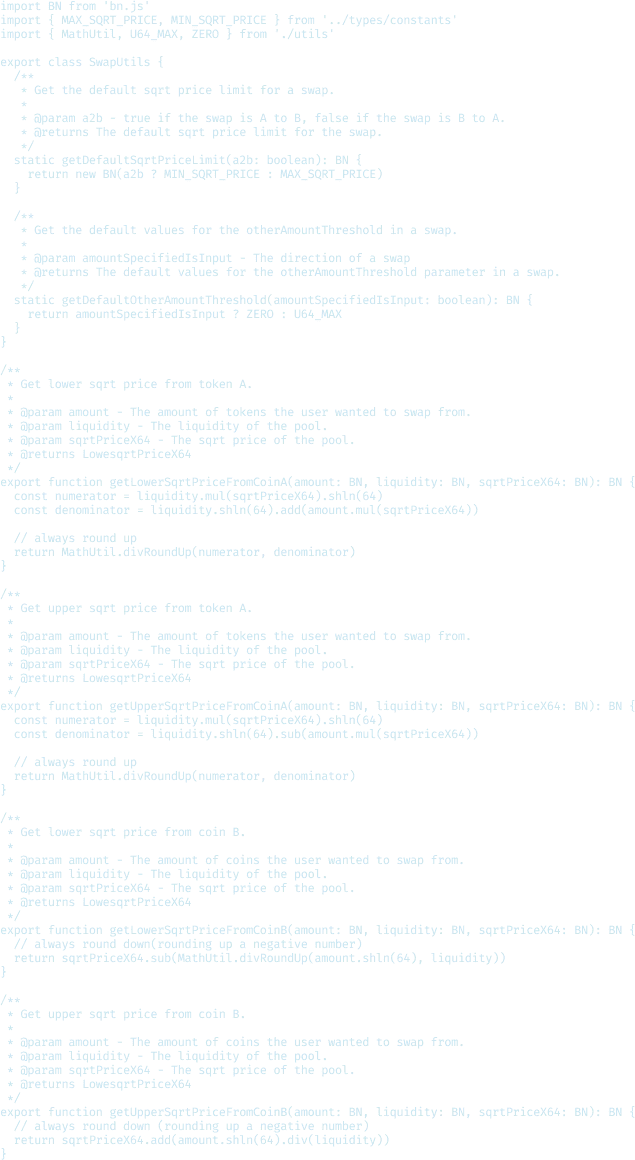
A quote estimates a trade’s output. Wallet approval authorizes a transaction; its completed on-chain result records the actual outcome.
Swap fees and network gas are different costs. The swap fee follows the pools and route used, while Sui gas pays for computation and storage. Price impact reflects execution against liquidity; slippage concerns movement between the estimate and execution. For fixed-input swaps, a minimum-output limit bounds the acceptable result. Raising tolerance allows a larger departure from the quote; it doesn’t add liquidity to a thin market.
CLMM, DLMM, and vaults make different liquidity choices
CLMM ranges define active liquidity
A concentrated liquidity market maker (CLMM) lets providers place assets within a selected price range on Sui. The platform also supports permissionless pool creation, with selectable fee tiers. Range selection affects how much capital participates near the current market price. Each position has its own bounds, so a pool’s total deposits don’t show how much liquidity is active at a particular price. Outside its range, a position becomes inactive and holds a single asset. Price changes can also leave a provider holding less value than simply holding the original assets, a risk called impermanent loss.
An inactive CLMM position stops earning new swap fees. Its liquidity becomes active again when the market price returns inside the range.
DLMM bins set prices locally
The dynamic liquidity market maker (DLMM) organizes liquidity into discrete price bins. Trades within an active bin use its fixed price. When liquidity on one side runs out, execution moves to the next bin in that direction. A larger trade can cross bins and reach different prices. Its dynamic trading fee combines a base fee with a variable component that responds to market volatility.
Vaults automate management while farms add incentives
Cetus Vaults automate liquidity management on the concentrated liquidity pools. Their strategies can harvest and reinvest earnings, adjust price ranges, and match deposits to the pool’s required token composition. A single-asset deposit can involve converting part of that asset into the other token that the pool needs. Rebalancing responds to price changes by adjusting where the strategy supplies liquidity. Liquidity mining and farming add rewards under the relevant pool or programme rules. These incentives supplement fee earnings, with their own eligibility and distribution conditions.
The deposited assets remain exposed to price movements and the strategy’s trading decisions.
Intent trading changes the timing of token purchases
Intent Trading includes limit orders and dollar-cost averaging (DCA), which separate a trading instruction from immediate execution.
Limit orders wait for a target price
A limit order adds a target price and expiry to the trade. A fully filled order follows this path, provided market conditions permit execution before expiry.
| Limit-order stage | Order inputs and conditions |
|---|---|
| Select the tokens to sell and buy | A supported trading pair |
| Enter the order amount | The chosen input amount or desired output amount |
| Set the exchange price | The price expressed in the intended direction |
| Choose an expiry | A deadline for the open order |
| Submit the order for wallet approval | Confirmed amounts, price, and expiry |
| Price-triggered order execution | Available liquidity and market conditions that permit a complete fill |
| Receive the purchased tokens | A complete fill for automatic delivery to the wallet |
DCA spreads execution across time
DCA schedules repeated purchases at chosen intervals. Each scheduled trade encounters the liquidity and price available at execution. Spreading purchases across time changes the entry schedule, without fixing a future average price. A limit order ties execution to a target price; DCA ties repeated execution to a schedule.
CETUS and xCETUS connect incentives with participation
On Sui, CETUS is the protocol token, and xCETUS is its escrowed staking counterpart. Staking rewards draw on net protocol fee profits. Redemption back to CETUS involves vesting. The governance design conditions voting activation on circulating CETUS reaching at least 90% of total supply. Launchpad events can use xCETUS balances for eligibility or buying quotas, under their own rules.
The CLMM exploit remains relevant to deposited assets
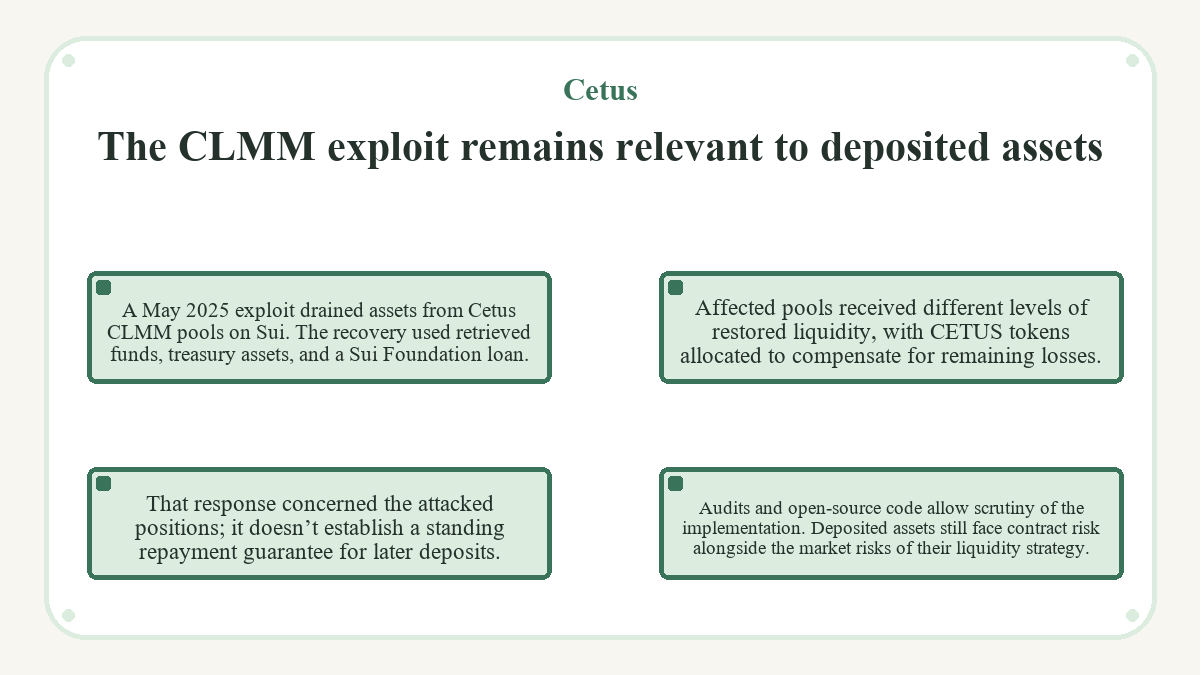
A May 2025 exploit drained assets from Cetus CLMM pools on Sui. The recovery used retrieved funds, treasury assets, and a Sui Foundation loan. Affected pools received different levels of restored liquidity, with CETUS tokens allocated to compensate for remaining losses. That response concerned the attacked positions; it doesn’t establish a standing repayment guarantee for later deposits. Audits and open-source code allow scrutiny of the implementation. Deposited assets still face contract risk alongside the market risks of their liquidity strategy.
Launchpad, margin, and integrations extend the trading platform
Asset Launch and the launchpad support token launches in the Sui ecosystem. Creating a market and arranging token distribution are separate functions; a launch doesn’t establish ongoing trading demand. The incubator adds grant funding and technical, operational, and business support for selected Sui projects. Cetus Pro adds trending-token discovery and on-chain activity analysis. Merge Swap can convert multiple supported tokens into one asset within a single transaction. These tools expand market discovery and trade composition beyond an individual pair quote.
Cetus combines swap aggregation with liquidity pools
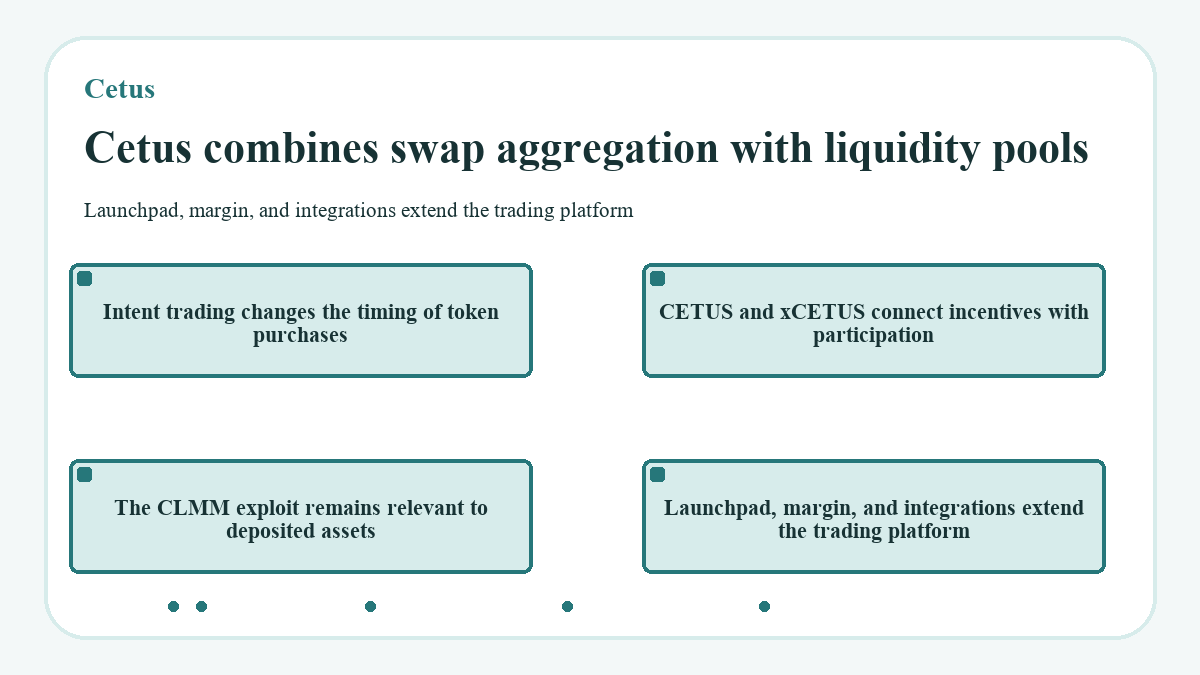
- Intent trading changes the timing of token purchases
- CETUS and xCETUS connect incentives with participation
- The CLMM exploit remains relevant to deposited assets
- Launchpad, margin, and integrations extend the trading platform
Cetus Margin supports leveraged long and short positions. Available leverage varies by market and lending conditions. Collateral can be the market’s base or quote asset. A position can face liquidation when its loan-to-value (LTV) reaches the market’s liquidation threshold. This product is separate from DeepBook Margin accessed through the same interface. Borrowing introduces a debt obligation, so the position’s health depends on collateral and debt as well as its trading performance.
Applications can access the liquidity network through TypeScript software development kits (SDKs) or direct Move contract integration. SDKs package queries, liquidity operations, and frontend data handling. The aggregator SDK handles route discovery and swap construction, while pool SDKs address the relevant liquidity model. Cetus Terminal provides an embeddable version of the aggregator for websites and applications. These integration tools target Sui. A separate Aptos version has its own swap and pool interface. An integration therefore needs packages and contracts that match its network and chosen function.
Cetus: questions and answers
-
Can I collect swap fees without closing my CLMM position?
- You can claim accumulated CLMM swap fees without withdrawing your liquidity. The protocol accounts for those fees separately from the position’s deposited assets. Claiming earnings therefore doesn’t require closing the position, and it doesn’t change the rule that new swap fees accrue only while the market price is inside its range.
-
Does a pool’s displayed APR include impermanent loss?
- The displayed annual percentage rate (APR) doesn’t include impermanent loss. It projects 24-hour trading activity and token emissions over a year. That estimate doesn’t measure the difference between the position’s value and holding its original assets. Changes in trading activity, reward emissions, and the assets’ relative prices can therefore change the actual outcome.
-
How long does xCETUS redemption take?
- Redemption has a selected vesting period from 15 to 180 days. The 15-day choice returns 0.5 CETUS per xCETUS redeemed, while 180 days returns 1 CETUS per xCETUS. CETUS becomes claimable after the chosen period ends. Vesting below the maximum forfeits part of the corresponding CETUS, so the wait affects both access and the amount received.
-
Can I send xCETUS to another wallet?
- xCETUS is non-transferable and can’t be sent to another wallet through an ordinary token transfer. It represents escrowed CETUS in the protocol. Converting it back into transferable CETUS requires redemption under the vesting rules.
-
What happens to an expired limit order that was partly filled?
- Expiry cancels the remaining order and returns its unfilled input tokens to the user. Purchased tokens from completed fills are a separate balance. Partial purchases can be claimed while an order remains open; cancellation distributes already purchased tokens alongside the returned unfilled amount. Expiry doesn’t reverse the trades that have already filled.
-
Is xCETUS staking supported on Aptos?
- xCETUS staking is available on Sui but the xCETUS documentation doesn’t confirm staking support on Aptos. The Aptos deployment has its own swap and pool interface. xCETUS balances and staking contracts belong to the Sui system, so a wallet connection on Aptos doesn’t provide access to a staking position on Sui.
-
Do I need to buy CETUS before making a swap?
- Buying CETUS isn’t a general prerequisite for making a token swap. A swap requires the selected input asset and a valid transaction gas payment. Standard Sui gas payments use SUI. An application’s sponsorship arrangements can change who supplies that gas, while CETUS and xCETUS have separate protocol participation functions.