 Cetus
Cetus
Cetus concentrated liquidity ties fee participation to the price range you choose
Last updated -
Cetus concentrated liquidity allocates deposited assets to a selected interval in a concentrated liquidity market maker (CLMM) pool. Narrower bounds concentrate more liquidity around the pool price, increasing capital efficiency while that price stays inside. Wider bounds cover more price movement with less concentration. Choosing a range sets where your assets can support swaps and earn trading fees.
The Sui CLMM represents each position through a non-fungible token (NFT) with its own bounds. Range selection also determines the required asset mix, so a useful choice connects price coverage with the inventory you’re willing to hold.
Narrower bounds increase concentration near the pool price
Reducing range width increases the liquidity that a fixed deposit can contribute near the same pool price. This comparison assumes equal deposit value in the same pool, with both intervals containing that price and the narrower interval contained within the wider one. A larger liquidity contribution can increase the position’s share of fees from trades within its bounds. It doesn’t establish how much trading will occur there.
A wider interval covers movements that would exceed tighter bounds, spreading the deposit across more prices. Concentration falls, but the position can remain active through a larger price move. Compare these options against the pair’s relative price movement and the attention that range management requires. An off-center interval also leaves unequal room above and below the current price, changing the exposure you’re choosing.
Ticks connect the interval to the required assets
Lower and upper ticks define the position’s boundaries, while the pool price determines the asset mix within those bounds.
The pool’s spacing
Each pool has a tick spacing that restricts valid boundary indices. Both indices must be integer multiples of that spacing. A decimal price that falls between valid boundaries needs conversion to an aligned tick. The accepted interval can therefore differ slightly from the prices that you initially entered.
The required token mix
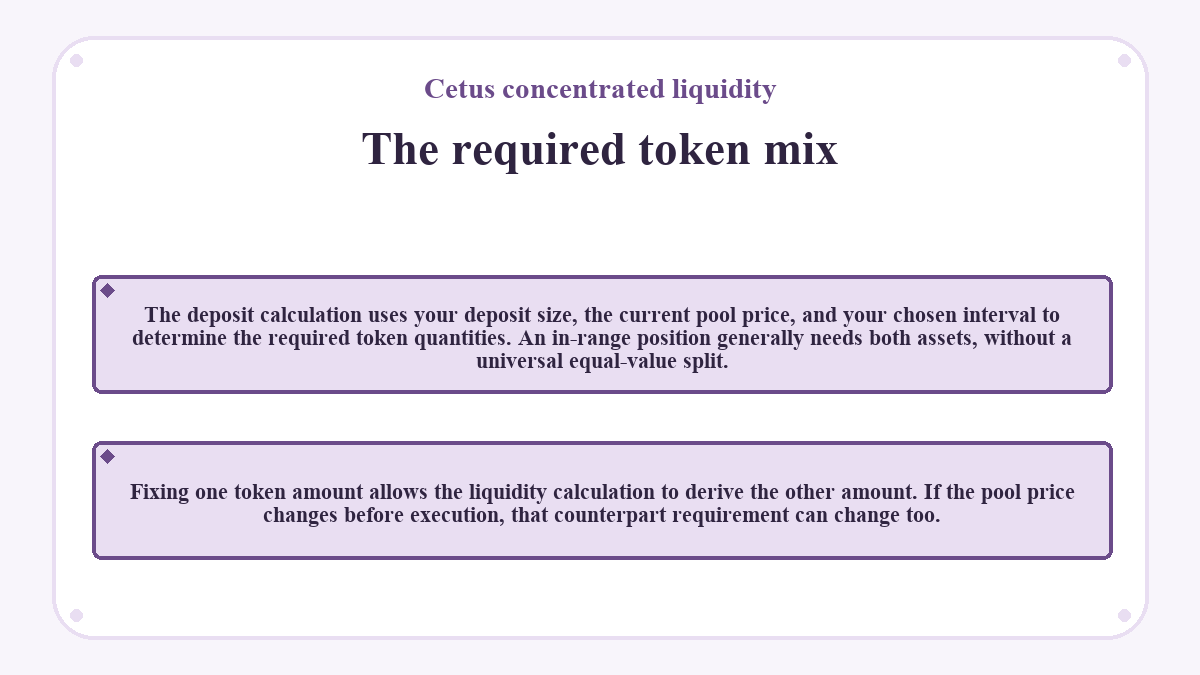
The deposit calculation uses your deposit size, the current pool price, and your chosen interval to determine the required token quantities. An in-range position generally needs both assets, without a universal equal-value split. Fixing one token amount allows the liquidity calculation to derive the other amount. If the pool price changes before execution, that counterpart requirement can change too.
Fee income follows the liquidity that handles each swap
Fee income reflects your share of active liquidity and the swaps that use it. Cetus allocates the liquidity-provider share of swap fees proportionally among the CLMM positions active at the swap price. The trade’s input token determines the fee token. Pool-wide deposited value includes positions that may be inactive, so it doesn’t directly describe the competition for fees at the current price.
An active status establishes eligibility to earn new swap fees; actual earnings require trading through the position’s interval. Other providers can add liquidity around the same price and change your share. Fees accumulate separately from the deposited assets, and the protocol takes its applicable portion of swap fees. Any additional mining rewards depend on the pool’s incentive program. Those rewards add a separate income component without changing the selected bounds.

What happens when the pool price leaves my range?
A position outside its bounds holds one pooled asset and stops earning new swap fees. Swaps change the token composition as the price passes through the interval. Which asset remains depends on the side that the price exits and the quotation convention. The range boundary doesn’t preserve the original quantities that you deposited.
If liquidity remains in the position, a return inside its bounds makes it active again. Its selected interval hasn’t moved.
This changing inventory explains the exposure to impermanent loss, the difference between providing liquidity and holding the original assets. Fee income can offset that difference, although it needn’t cover it. Concentrated positions amplify both potential fee yield and the effect of price movement on that comparison. A position can therefore earn fees while its value trails the value of holding the starting token quantities. Returning to an active status establishes renewed participation; it doesn’t establish that the earlier difference has disappeared.
From a selected interval to a funded position
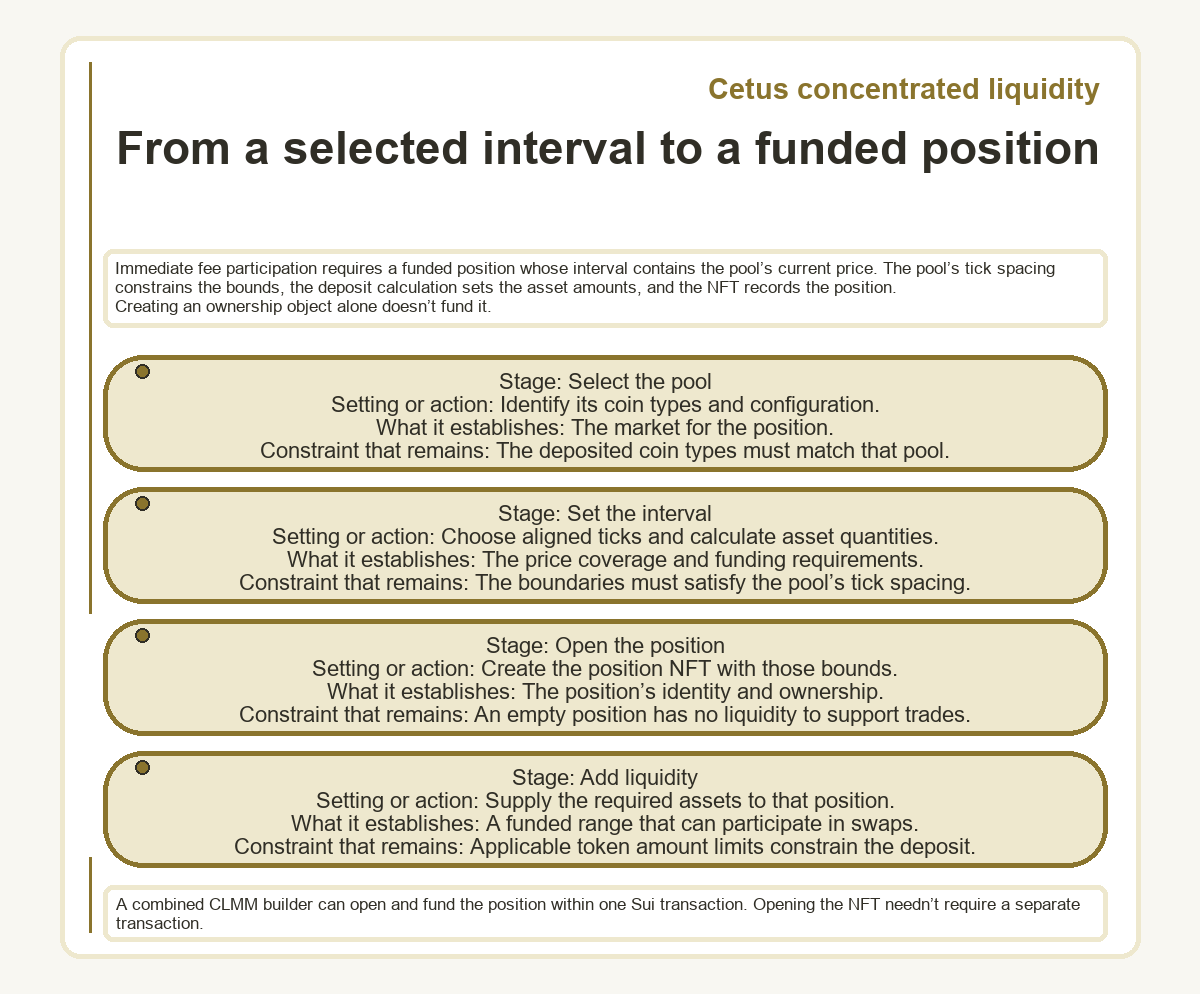
Immediate fee participation requires a funded position whose interval contains the pool’s current price. The pool’s tick spacing constrains the bounds, the deposit calculation sets the asset amounts, and the NFT records the position.
Creating an ownership object alone doesn’t fund it.
| Stage | Setting or action | What it establishes | Constraint that remains |
|---|---|---|---|
| Select the pool | Identify its coin types and configuration. | The market for the position. | The deposited coin types must match that pool. |
| Set the interval | Choose aligned ticks and calculate asset quantities. | The price coverage and funding requirements. | The boundaries must satisfy the pool’s tick spacing. |
| Open the position | Create the position NFT with those bounds. | The position’s identity and ownership. | An empty position has no liquidity to support trades. |
| Add liquidity | Supply the required assets to that position. | A funded range that can participate in swaps. | Applicable token amount limits constrain the deposit. |
From a selected interval to a funded position
- Stage: Select the pool Setting or action: Identify its coin types and configuration. What it establishes: The market for the position. Constraint that remains: The deposited coin types must match that pool.
- Stage: Set the interval Setting or action: Choose aligned ticks and calculate asset quantities. What it establishes: The price coverage and funding requirements. Constraint that remains: The boundaries must satisfy the pool’s tick spacing.
- Stage: Open the position Setting or action: Create the position NFT with those bounds. What it establishes: The position’s identity and ownership. Constraint that remains: An empty position has no liquidity to support trades.
- Stage: Add liquidity Setting or action: Supply the required assets to that position. What it establishes: A funded range that can participate in swaps. Constraint that remains: Applicable token amount limits constrain the deposit.
A combined CLMM builder can open and fund the position within one Sui transaction. Opening the NFT needn’t require a separate transaction.
Manual bounds and vault rebalancing create different exposure
A manually managed CLMM position keeps its selected bounds, while a vault applies a strategy that can replace ranges.
Keeping control of the interval
Adding liquidity to an existing position increases its liquidity without choosing a different interval. Allocating capital to different bounds requires another position. Manual management lets you preserve the exact range that you selected. Repositioning capital changes the asset requirements and involves on-chain operations, with transaction costs that affect the value of frequent adjustments.
Delegating price-range management
Cetus Vaults monitor price ranges and rebalance liquidity through their strategy. They also reinvest collected fees and rewards, and support converting part of a single-asset deposit into the required paired asset. This changes who manages the range and how earnings return to the pool. The strategy adds conversion and rebalancing decisions to the exposure from holding pooled assets. Automated management doesn’t make a position immune to market losses or contract failures. A vault’s fungible liquidity tokens also differ from the NFT that represents an individual direct CLMM position.
Fee tiers influence the pool choice alongside the range
The fee that the pool charges affects potential revenue, while its trading activity determines how often that fee applies. Cetus permits separate pools for the same token pair with different fee tiers. A higher tier doesn’t establish higher earnings if fewer swaps use that pool. Compare range width and fee tier as distinct choices, keeping the pool’s active liquidity in view. Swap aggregation can distribute trading across different liquidity sources, so total activity across Cetus doesn’t measure the demand for a particular CLMM interval.
Range width doesn’t protect the underlying contracts
Range width controls price exposure and trading participation; it doesn’t insure deposits against a contract vulnerability. The position NFT records ownership without certifying the pool’s security. Sui transaction costs also remain part of manual management. Computation, storage, and any storage rebate determine the net gas cost, so the gas budget isn’t necessarily the amount ultimately paid. Frequent repositioning adds these execution costs to the economic comparison between narrower and wider coverage.
The 2025 attack on Cetus CLMM pools exploited a vulnerability in a CLMM-dependent library. Cetus patched the vulnerability and audited the fixes as part of its recovery work. The recovery combined returned assets, treasury funding, and a Sui Foundation loan to refill affected pools. The June 2025 recovery plan reported liquidity recovery rates of 85% to 99% across affected pools.
Common questions about Cetus concentrated liquidity
Can I hold several CLMM positions in the same Cetus pool?
You can hold multiple CLMM positions in the same pool with independent price ranges. Each position retains its own bounds and liquidity amount. This permits different allocations within one market, although overlapping positions still compete with the pool’s other active liquidity for the liquidity-provider share of swap fees.
Does reversing the displayed token order change my range?
Reversing a price quotation reciprocates the displayed boundaries of the same range. If its lower and upper prices are L and U, the inverse quotation runs from 1/U to 1/L. Reading that inverse quote doesn’t change the underlying position. Compare the current price and both boundaries using the same token order.
Why can a CLMM position show earned fees while it is out of range?
An out-of-range position can retain fees that it earned before the price left its interval. Cetus accumulates those fees separately from the deposited liquidity. A displayed accrued balance can therefore coexist with an inactive position. It doesn’t mean that the position continues earning new swap fees outside its bounds.
Can I remove only part of a CLMM position’s liquidity?
Liquidity removal can specify part of the position’s liquidity amount without closing the entire position. The remaining liquidity keeps the same price bounds. Its participation still depends on the pool price lying inside that interval. The withdrawn token quantities follow the position’s composition when removal executes.
How does deposit slippage tolerance differ from CLMM range width?
Deposit slippage tolerance addresses changing token requirements during liquidity addition, while range width defines the position’s price coverage. When adding a specified liquidity amount, the calculation can apply slippage adjustments to maximum amounts for both tokens. With one coin amount fixed, pool-price changes affect the calculated counterpart requirement. Increasing tolerance doesn’t widen the selected interval.
Why did the 2025 recovery plan retain NFTs from affected CLMM positions?
The 2025 recovery plan retained affected position NFTs because they identified entitlement to CETUS compensation. Under that plan, an affected NFT remains proof of that entitlement after full liquidity withdrawal. This special role applies to positions affected by that incident; ordinary position ownership doesn’t establish compensation coverage for a new deposit.